
📊 Full opportunity report: When-to-replace planner for data center equipment on IdeaNavigator AI — validation score, market gap, and execution plan.

Get smart everyday buys delivered free with Prime
- Fast, free delivery on millions of items
- Prime Video, Amazon Music and more included
- Member-only deals all year
TL;DR
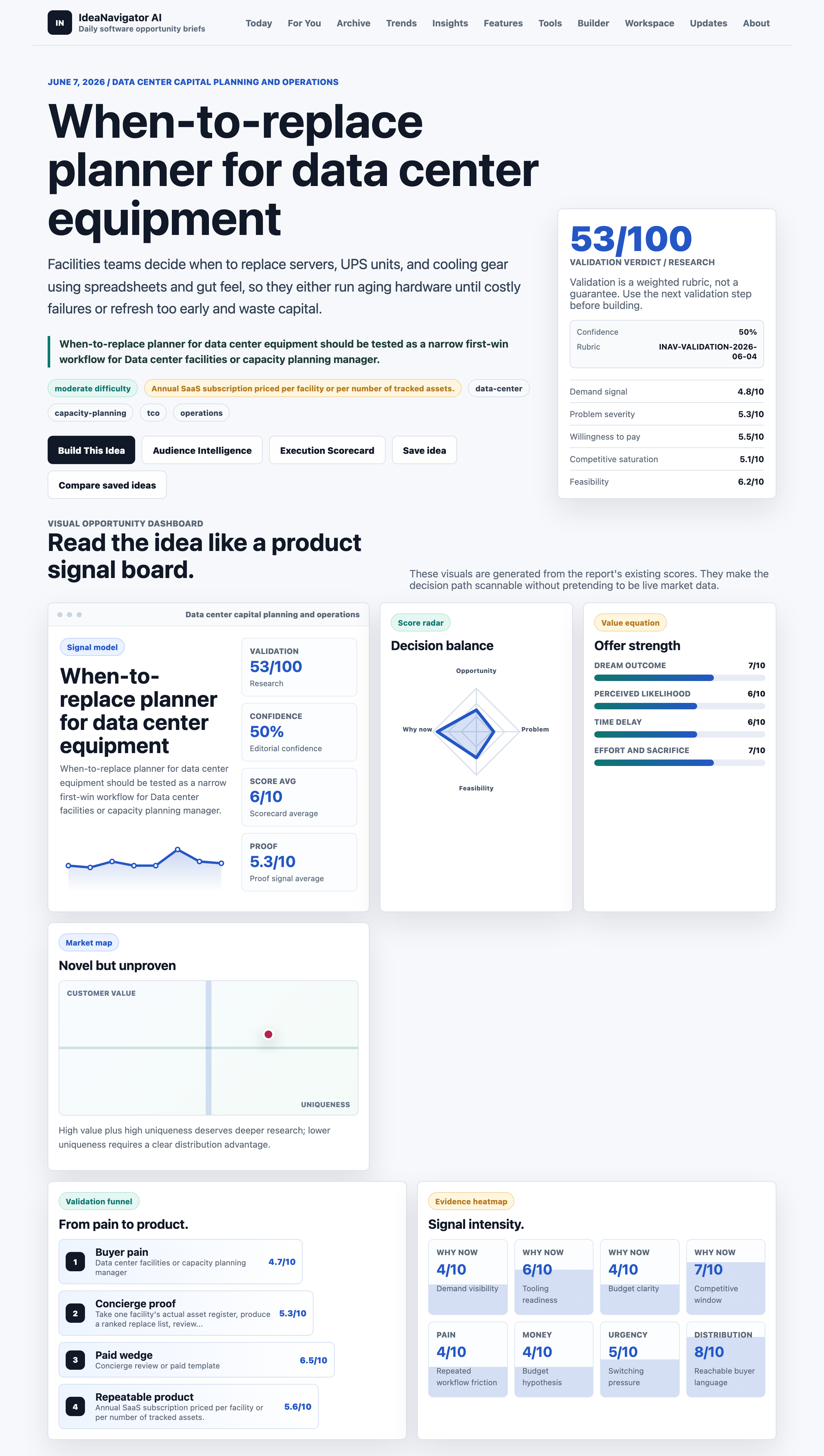
A prototype ‘when-to-replace’ planner for data center equipment is being tested to help facilities managers decide when to upgrade servers, UPS, and cooling systems. The tool aims to reduce costs and improve efficiency amid rising energy prices.
A new ‘when-to-replace’ planning tool for data center equipment is being tested as a targeted workflow for facilities and capacity planning managers, aiming to optimize hardware refresh cycles based on data rather than intuition.
The proposed tool ingests data on a facility’s asset list, including age, power consumption, and maintenance costs, then generates a ranked list of equipment to replace now versus keep. This approach seeks to address the traditional reliance on spreadsheets and gut feeling, which often leads to either premature upgrades or costly failures due to aging hardware.
Developed as a minimum viable product (MVP), the planner evaluates rising energy costs and failure risks against the efficiency gains of newer hardware. It is designed to be implemented via a SaaS subscription, priced per facility or per number of assets tracked. The validation process involves applying the tool to an actual facility’s asset register, comparing its recommendations with the facility’s current plan, and measuring the level of agreement with the capacity manager.
Why It Matters
This development matters because data center operators face increasing pressure to manage costs amid rising energy prices and hardware density. An objective, data-driven decision-making process can reduce unnecessary capital expenditure and prevent failures, ultimately improving operational efficiency and sustainability.
data center server replacement tools
As an affiliate, we earn on qualifying purchases.
As an affiliate, we earn on qualifying purchases.
Background
Currently, facilities teams often rely on manual methods—spreadsheets and experience—to determine equipment replacement timing. As hardware ages, the risk of failure and energy inefficiency grows, complicating decisions. The emergence of this planning tool reflects a broader industry shift toward automation and data-driven asset management, driven by rising operational costs and the need for more precise capacity planning.
“This tool could significantly improve how data centers decide on hardware refreshes, moving from intuition-based to data-driven decisions.”
— an anonymous researcher
UPS maintenance and replacement kits
As an affiliate, we earn on qualifying purchases.
As an affiliate, we earn on qualifying purchases.
What Remains Unclear
It is not yet clear how accurately the tool’s recommendations will align with real-world operational needs or how widely it will be adopted after initial testing. The effectiveness of the model depends on the quality of input data and its ability to adapt to different facility configurations.
cooling system upgrade for data centers
As an affiliate, we earn on qualifying purchases.
As an affiliate, we earn on qualifying purchases.
What’s Next
Next steps include completing pilot testing at selected facilities, gathering feedback from capacity managers, and refining the algorithm. If successful, the vendor plans to expand deployment and develop additional features based on user input.
energy-efficient data center hardware
As an affiliate, we earn on qualifying purchases.
As an affiliate, we earn on qualifying purchases.
Key Questions
How does the ‘when-to-replace’ planner work?
The planner analyzes asset data such as age, power consumption, and maintenance costs to generate a ranked list of equipment to replace, balancing energy efficiency improvements against failure risks and costs.
Who can use this planning tool?
It is designed for data center facilities or capacity planning managers responsible for hardware refresh decisions.
What are the main benefits of using this tool?
It aims to reduce unnecessary capital expenditure, prevent costly failures, and improve energy efficiency by providing data-driven replacement recommendations.
When will the tool be commercially available?
The tool is currently in pilot testing; commercial availability will depend on pilot outcomes and further development, with no specific timeline announced yet.
Source: IdeaNavigator AI
Halloween Picks
halloween
As an affiliate, we earn on qualifying purchases.