
📊 Full opportunity report: Key Compliance Measures For Pesticide Residues In Food Imports on IdeaNavigator AI — validation score, market gap, and execution plan.

Get smart everyday buys delivered free — and shop member deals
- Fast, free delivery on millions of items
- Access to Prime Big Deal Days deals on October 6–7
- Prime Video, Amazon Music and more included
TL;DR
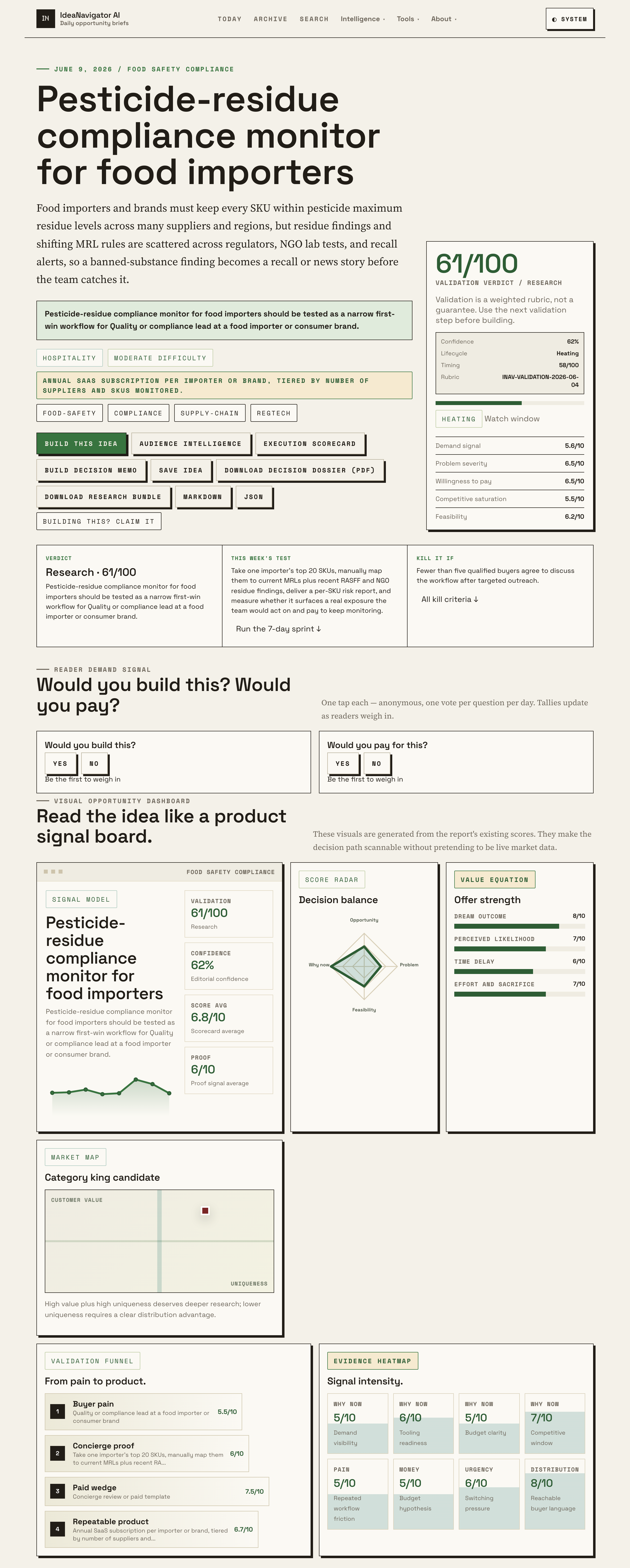
Regulators and NGOs are increasingly detecting banned pesticides in imported staples. A new compliance monitor tool aims to help importers proactively manage residue risks. The development is in early testing stages, with potential to improve food safety oversight.
Food importers and brands are facing growing pressure to ensure their products meet increasingly strict pesticide residue limits. A new compliance monitoring tool, currently in development, aims to help them proactively identify and manage residue risks before products reach consumers. This initiative responds to rising detection of banned pesticides in staples like rice, tea, and spices, and the tightening of maximum residue levels (MRLs) across markets.
The proposed pesticide-residue compliance monitor will map a brand’s suppliers and SKUs against current EU and regional MRLs, as well as recent public residue findings from sources such as RASFF alerts and NGO tests. The tool will flag products at risk of exceeding residue limits and generate audit-ready compliance briefs for each SKU. This approach aims to reduce the likelihood of recalls and regulatory violations, while streamlining compliance workflows for importers.
According to an anonymous industry source, the minimum viable product (MVP) involves manually mapping a sample of top SKUs to current MRLs and recent residue alerts, then assessing whether the system can accurately identify products with potential exposure risks. The goal is to validate whether this process can be scaled into an automated SaaS solution, with tiered subscription pricing based on the number of suppliers and SKUs monitored.
Why This Compliance Tool Could Transform Food Import Safety
This development is significant because it addresses a critical gap in current food safety practices. Importers often struggle to keep pace with evolving pesticide regulations and scattered residue findings, which can lead to unintentional violations and costly recalls. A proactive monitoring system could enable brands to identify risks earlier, reduce compliance costs, and improve consumer safety.
As NGOs and regulators continue to surface banned pesticides in widely consumed staples, the pressure on importers to demonstrate residue compliance intensifies. The tool’s ability to provide real-time, audit-ready reports could also facilitate transparency and accountability in supply chains, aligning with retailer demands for documented residue management.
pesticide residue testing kit for food
As an affiliate, we earn on qualifying purchases.
As an affiliate, we earn on qualifying purchases.
Rising Detection of Banned Pesticides in Imported Staples
Over recent years, NGOs and regulators have increasingly identified EU-banned pesticides in imported foods such as rice, tea, and spices. These findings often lead to recalls and negative publicity for brands, highlighting the need for better risk management. Meanwhile, tightening MRL standards across regions mean that products previously considered compliant may now be at risk of violation, even without new testing.
Currently, many importers rely on manual tracking of MRLs and scattered residue alerts, which is labor-intensive and prone to oversight. The proposed compliance monitor aims to automate and centralize this process, providing a comprehensive view of residue risks across supply chains.
“Mapping residues and MRLs in real time could significantly reduce unintentional violations and improve food safety standards.”
— an anonymous researcher
food safety compliance monitoring tool
As an affiliate, we earn on qualifying purchases.
As an affiliate, we earn on qualifying purchases.
Development Stage and Validation Uncertainties
It is not yet clear how effectively the initial manual mapping and risk assessment will scale into an automated SaaS platform. The accuracy of the system in real-world testing, as well as its ability to integrate diverse regional data sources, remains to be validated during pilot testing with select importers. Additionally, the timeline for full deployment and adoption is still uncertain.
imported food pesticide residue test
As an affiliate, we earn on qualifying purchases.
As an affiliate, we earn on qualifying purchases.
Next Steps for Pilot Testing and Market Rollout
The development team plans to pilot the monitoring tool with one or more importers, focusing on their top 20 SKUs. They will assess whether the system can accurately flag residue risks and produce compliance reports. Based on pilot results, further refinement and automation will be pursued, with a view to offering the platform as a subscription service in the near future. Broader adoption will depend on validation outcomes and user feedback.
regulatory compliance food testing
As an affiliate, we earn on qualifying purchases.
As an affiliate, we earn on qualifying purchases.
Key Questions
How will the monitoring tool identify pesticide residue risks?
The tool will map SKUs to current MRLs, recent residue alerts from sources like RASFF and NGO tests, and flag products that exceed or are close to limits, providing risk reports for compliance management.
When will the tool be available for commercial use?
Full deployment depends on pilot validation, which is expected within the next few months. If successful, a SaaS platform could launch within six to twelve months.
Will this system cover all regional regulations?
The initial focus is on EU and regional MRLs, with plans to expand coverage as data sources and regional regulations are integrated into the platform.
How does this benefit food importers and brands?
It offers a proactive approach to managing pesticide residue risks, reducing the likelihood of violations and recalls, and streamlining compliance documentation processes.
What are the limitations of the current development stage?
The system’s accuracy and scalability are still being tested. Its effectiveness in diverse supply chains and regions remains to be confirmed during pilot testing.
Source: IdeaNavigator AI
Fall Picks
fall essentials
As an affiliate, we earn on qualifying purchases.