
📊 Full opportunity report: What Heirs Can Look For In Financial Advice on IdeaNavigator AI — validation score, market gap, and execution plan.

Get smart everyday buys delivered free with Prime
- Fast, free delivery on millions of items
- Prime Video, Amazon Music and more included
- Member-only deals all year
TL;DR
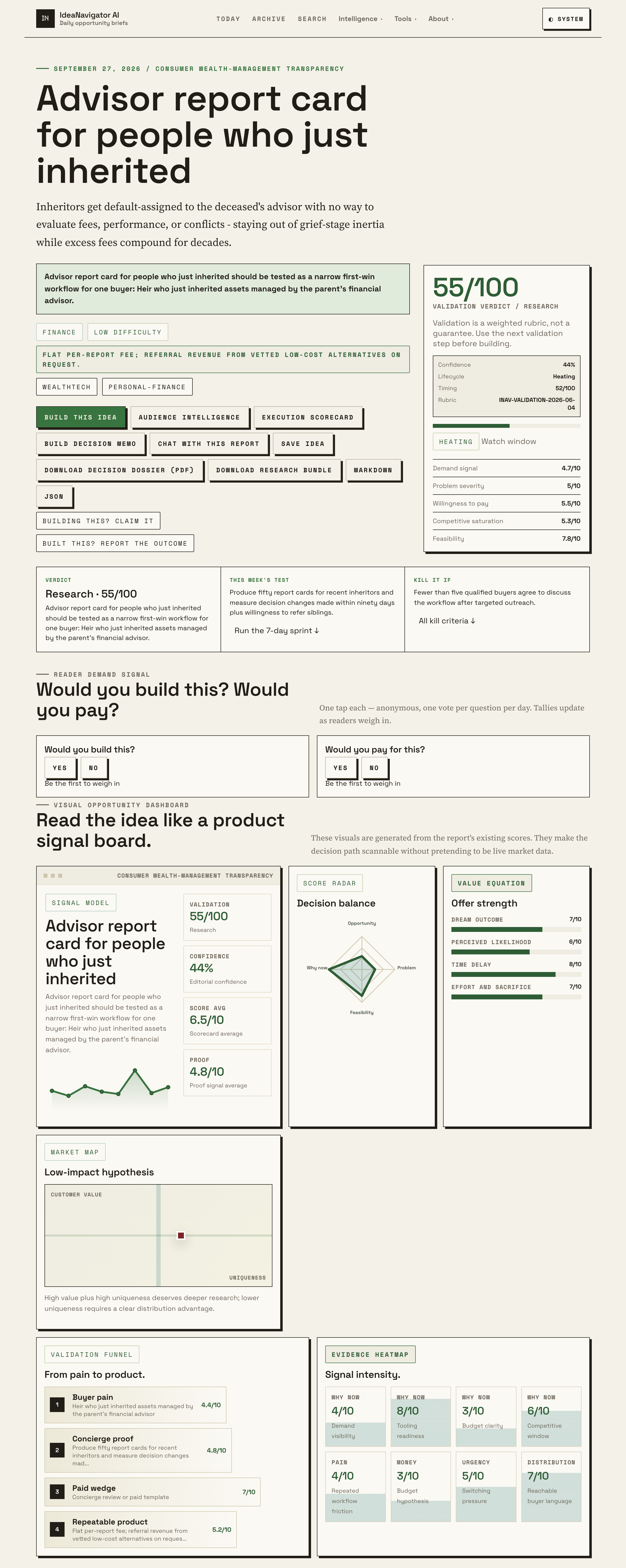
A proposal calls for a paid report card to help people who inherit assets managed by a parent’s financial adviser assess fees, regulatory records and disclosed conflicts. The concept is at the product-testing stage; there is no evidence yet that it changes heirs’ decisions or reduces costs.
The proposed service would ask an heir to enter the adviser’s name and upload account statements. It would then draw on publicly available regulatory information, including Form ADV disclosures, and use document parsing to estimate the all-in fees shown in statements. The planned report would also summarize disclosed conflicts and compare the adviser with alternatives.
The output would offer stay, negotiate or switch guidance, along with scripts for conversations with an adviser. These are features in a proposed minimum viable product, not an already validated service. The proposal does not describe how its comparisons would account for differences in investment strategy, service, tax circumstances or account types.
The suggested business model combines a flat fee per report with possible referral revenue if users request introductions to vetted, lower-cost alternatives. The proposal says the service should first be tested with one group: people who have recently inherited assets managed by their parent’s adviser. It does not identify a price or list specific referral partners.
A Check on Inherited Advice
An inheritance can leave a family member responsible for financial accounts and an adviser relationship they did not choose. A clear account of fees, disclosures and regulatory records could give heirs concrete questions to raise before deciding whether to continue that relationship.
The practical stakes depend on whether the report is accurate and useful. A fee comparison alone may not capture the value of financial planning, tax coordination or other services. And a referral business model could create potential conflicts of interest if recommended alternatives generate revenue. The proposal does not explain how referrals would be selected or how those incentives would be disclosed.
For now, the idea is a testable product hypothesis, not evidence that heirs are routinely overcharged or that switching advisers would improve outcomes. Its importance will turn on whether the report helps users make informed decisions without presenting incomplete comparisons as personalized financial advice.
From Inheritance to Adviser Review
The concept is framed around a wider transfer of wealth to heirs over the coming decade. It argues that public adviser disclosures and tools that parse financial documents could make some parts of adviser evaluation easier to automate. The proposal does not provide a specific estimate for the transfer or evidence about how often heirs retain a parent’s adviser.
Its narrow initial audience reflects a particular moment: an heir receives assets already managed by an adviser with an established relationship to the deceased. The report card would focus on evaluating that adviser, rather than offering general inheritance planning or comprehensive wealth management.
IdeaNavigator AI proposes a small validation exercise: prepare 50 report cards for recent inheritors, then track whether recipients make a decision change within 90 days and whether they would refer siblings. Those measures are proposed research questions; no completed test, participant feedback or decision-change figures are provided.
Pilot Results Still Pending
There are no reported findings on whether heirs want this service, what they would pay, or whether the report would lead them to stay, negotiate or switch. The suggested 50-person exercise has no published start date or results, and the proposal does not say how participants would be recruited or how a decision change would be verified.
It is also unclear how the service would calculate total costs across different account statements, check the accuracy of parsed documents, or benchmark advisers whose offerings differ. Regulatory disclosures can identify reported information, but the proposal does not specify how it would handle incomplete records or distinguish a disclosed conflict from evidence of misconduct. The criteria for “vetted” alternatives and the handling of referral payments remain unspecified.
Testing Demand and Decisions
The next stated step is to produce 50 reports for recent inheritors and observe decisions over a 90-day period. A useful account of the test would report how many participants changed advisers or negotiated fees, how those changes were measured, and whether participants found the report accurate and understandable.
Further details would also be needed on report pricing, the methods used to calculate fees and compare advisers, and any referral arrangements. Until such information or pilot findings are available, the proposal remains an early-stage product concept rather than a demonstrated consumer service.
Key Questions
What is the proposed adviser report card?
It is a proposed service for recent heirs that would review an adviser’s regulatory information, disclosed conflicts and fees estimated from account statements, then offer stay, negotiate or switch guidance.
Is the service already available or tested?
The proposal describes a minimum viable product and suggests testing 50 reports. It provides no launch details or results from a completed pilot.
How would the service make money?
The proposed model is a flat fee for each report, with possible referral revenue when users ask for introductions to lower-cost alternatives. Pricing and referral terms have not been specified.
Would the report prove that an heir should switch advisers?
No. The concept is intended to inform a decision by comparing fees and disclosures, but no evidence is reported that its guidance improves outcomes. Adviser services and individual circumstances may differ.
What would the proposed pilot measure?
It would track whether recent inheritors change a decision within 90 days and whether they would refer siblings. No participant count beyond the proposed 50 reports or measurement results are reported.
What remains unknown about the comparisons?
The proposal does not explain the detailed benchmarking method, how statement-reading errors would be checked, or how referral incentives would be managed and disclosed.
Source: IdeaNavigator AI
Fall Picks
fall essentials
As an affiliate, we earn on qualifying purchases.